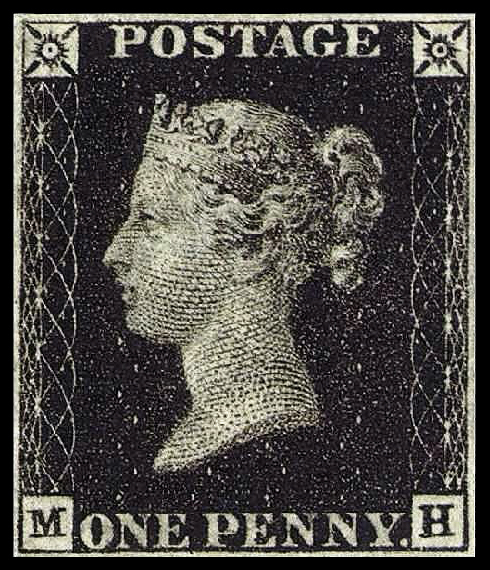
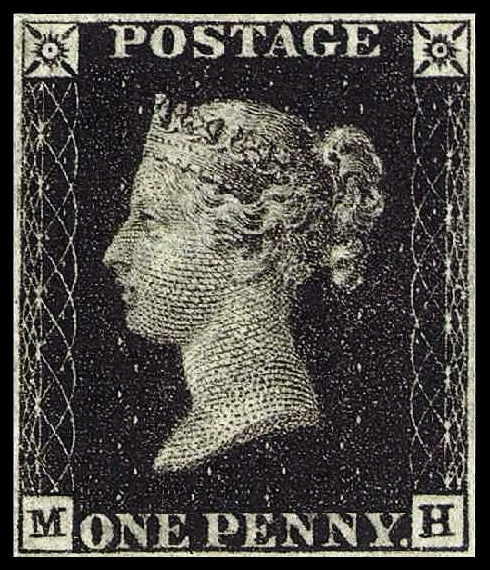
The Penny Black, issued by the British General Post Office on 6 May 1840, is the world’s first adhesive postage stamp. Designed by Henry Corbould following a design competition won by James Chalmers, the stamp depicts a silhouette of Queen Victoria after a portrait by William Wyon. The Penny Black represents the founding moment of modern philately and has been collected continuously since the year of its issue.
Postal Reform Context
Before 1840, British postage was paid by recipients based on distance and weight, with rates so high that the postal system was used primarily for business and government communication rather than personal letters. Sir Rowland Hill’s pamphlet “Post Office Reform” advocated a uniform penny rate prepaid by sender — a proposal adopted in 1839 and implemented through the Penny Black on 1 May 1840 (entering circulation 6 May). The reform transformed letter-writing into a mass activity and produced the modern postal system.
Plate Production
The Penny Black was printed from eleven plates, designated 1a through 11. Each plate produced subtly different impressions due to wear, re-engraving, and printing variations. The corner letters on each stamp identify its position within the printing sheet — for instance, “AA” indicates the top-left position of plate one. Plate identification is a deep specialty within Penny Black collecting and significantly affects value within the issue.
Cancellation Conventions
Penny Blacks were cancelled with red Maltese cross handstamps in the early issue period — a colour combination that proved inadequate because the red was easily removed for reuse. By 1841 the Maltese cross was switched to black ink and the stamp itself was reissued as the Penny Red. Penny Blacks with original red Maltese cross cancellations are valued for their period authenticity; Penny Blacks with black cancellations are later in the issue period and slightly more affordable.
Surviving Population
An estimated 68 million Penny Blacks were produced during the issue’s roughly twelve-month life. Surviving population is significant but uneven by condition: most surviving examples are used and in average condition, with mint examples and pristine used examples scarce. The very best examples — full original gum, perfect centring, light cancellation, full margins — sit at the top of the Penny Black market and command four- and low-five-figure prices.
Plate 11 Rarity
Plate 11 of the Penny Black was used briefly at the very end of the issue period before the transition to the Penny Red. Plate 11 stamps are scarcer than other plates because of the short production window. Plate 11 examples in high grade command meaningful premiums over equivalent stamps from earlier plates.
Authentication
Counterfeit Penny Blacks are a long-standing concern. Authentication relies on examination of the printing characteristics, the corner letters, the watermark (Small Crown), the centring, and the cancellation. For high-value examples, an expert certificate from the Royal Philatelic Society Expert Committee or the Philatelic Foundation is essential.
Cultural and Numismatic Significance
The Penny Black is more than a stamp: it is a milestone artefact of the Victorian era and the foundation document of modern postal communication. The image of Queen Victoria’s silhouette on the Penny Black is the most reproduced philatelic image in history. For a beginning philatelist, owning a Penny Black is the equivalent of a coin collector owning an early Greek tetradrachm — a tangible link to a civilisation-shaping moment.
Buying Considerations
Penny Blacks are widely available at the entry tier; common-plate used examples in average condition can be acquired for modest prices. Building toward higher grades and rarer plates requires patience, reference reading, and ideally the support of a specialist dealer. The Royal Philatelic Society and the British Philatelic Trust both publish reference material that supports plate identification and grade assessment.
For wider context, see our most valuable stamps list, our introduction to philately, and the stamps hub.
About This collectible
The Penny Black (Great Britain, 1840) is a notable entry in the collectible category. Whether you are a seasoned collector or evaluating your first piece, understanding provenance, condition, and market context is essential for confident decisions. This guide summarizes what makes this item collectible and how to evaluate examples in the market.
Identification & Authentication
Authenticating a Penny Black (Great Britain, 1840) requires attention to period-correct materials, manufacturing marks, signatures, and chain of custody documentation. Where third-party authentication exists (PSA, JSA, Beckett, SGC, PCGS, NGC, or category-specific authenticators), graded examples carry significant premium over raw pieces. Consult a recognized authenticator before high-value purchases.
Valuation & Market Pricing
Values for the Penny Black (Great Britain, 1840) vary by condition, provenance, completeness, and demand. Track recent sold prices on major venues including Heritage Auctions, Goldin, Christie’s, Sotheby’s, and eBay completed listings to benchmark fair market value. Realized sales reflect true value; asking prices do not.
Condition & Grading
Condition is the largest variable affecting value. Use the grading scale appropriate to the category and document defects honestly. For graded items, verify certification numbers on the grader’s website. For raw items, photograph all surfaces under neutral lighting and disclose any restoration or imperfections.
Where to Buy & Sell
Reputable venues include major auction houses, established dealer networks, specialty shows, and vetted online marketplaces. Avoid private cash transactions with unknown parties for high-value pieces. Use buyer protection or escrow when transacting at scale.
Frequently Asked Questions
How do I know if my Penny Black (Great Britain, 1840) is authentic?
Authenticity is best confirmed by a recognized third-party authenticator. Visual inspection alone is rarely sufficient for high-value pieces.
What is a Penny Black (Great Britain, 1840) worth?
Value depends on condition, provenance, and completeness. Check recent sold prices on major auction venues for comparable examples.
Where should I sell my Penny Black (Great Britain, 1840)?
For high-value pieces, established auction houses with category expertise typically deliver the best results. For mid-market items, vetted online marketplaces or dealer networks balance reach and fees.
Does grading add value?
For most categories, third-party grading adds meaningful value to top-condition examples. For lower-grade pieces, the grading fee can exceed the value uplift.
🔎 Buying or Selling This Item?
Affiliate links will appear here once configured in Settings → General.