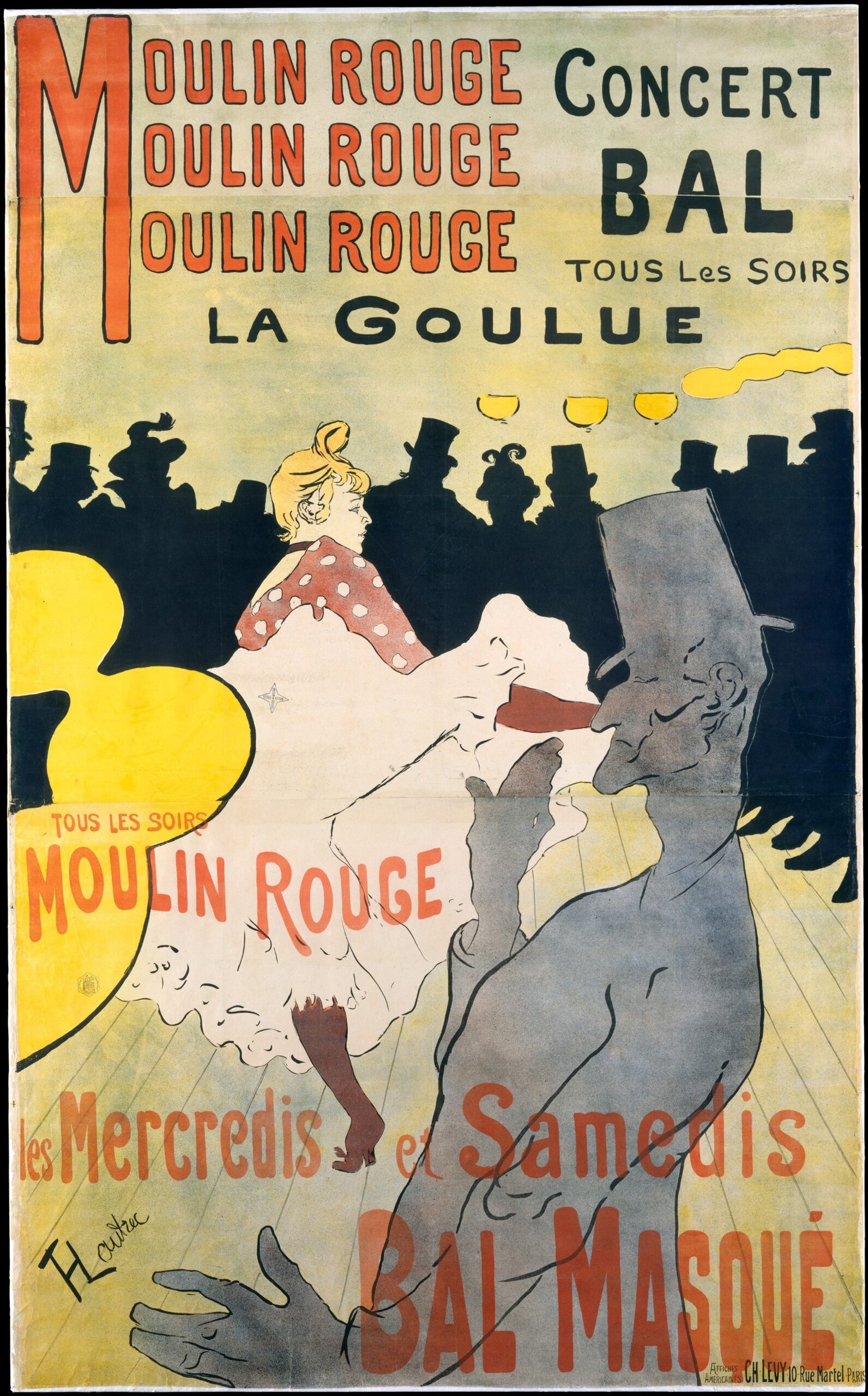
Henri de Toulouse-Lautrec’s 1891 lithograph poster Moulin Rouge: La Goulue is the work that elevated commercial poster art into fine art. Fewer than 30 first-printing examples are known to survive, and unrestored copies have sold at Christie’s and Sotheby’s for $500,000 to over $1.2 million. It is the cornerstone of any serious Belle Époque poster collection.
Why this poster matters
When the Moulin Rouge cabaret in Montmartre commissioned the 25-year-old Toulouse-Lautrec to advertise its star performer Louise Weber (“La Goulue”), nobody expected a small revolution. The artist used flat planes of color, dramatic silhouettes and a Japanese-inspired compositional style that broke every rule of 19th-century commercial illustration. The poster appeared overnight on Paris walls in October 1891, and within days collectors were peeling them down still wet. It launched the modern advertising poster as a serious art form and remains one of the most reproduced images in design history.
How to identify an original
The original 1891 printing measures roughly 191 × 117 cm (75 × 46 inches) — a striking three-sheet poster. It bears the imprint “Affiches Américaines, Charles Lévy, 10, rue Martel — Paris” along the bottom edge. The colors are limited to four lithographic stones — black, yellow, red and blue. Authentic copies show period-correct paper (a slightly textured, off-white wove), visible registration marks where the four stones overlapped, and stone-grain in the inked areas under raking light. Reproductions and later printings (1898, 1920s tourist editions, modern museum reprints) are common; provenance and a specialist’s opinion are essential.
Condition and conservation
Most surviving originals were displayed outdoors and show fold lines, paper loss at the edges, light staining and fading. Professional linen-backing — a reversible conservation treatment that mounts the poster onto archival linen — is standard and does not reduce value when done properly. Heavy in-painting, retouching or trimming, on the other hand, can cut value by 50% or more. Always request a current condition report from a specialist conservator.
Where to see one
Original 1891 examples are held by the Museum of Modern Art (New York), the Bibliothèque Nationale de France, the Toulouse-Lautrec Museum in Albi (the artist’s birthplace) and the Musée d’Orsay in Paris. Major poster auctions at Swann, Christie’s, Sotheby’s and Heritage typically include public previews where you can see the work at full scale.
For families and beginners
You can build a meaningful Toulouse-Lautrec collection on a modest budget. Affordable, museum-licensed reproductions cost $20–$100. Original lithographs from the artist’s estate edition (printed posthumously and clearly marked) range from $1,000 to $10,000. Children respond strongly to the bold colors and graphic simplicity of these posters — pairing one with a visit to a Belle Époque exhibit makes the period come alive.
Care and storage
Store framed, behind UV-filtering glazing (museum glass), away from direct sunlight. Keep humidity at 45–55% RH and temperature stable. Never display under harsh halogen or LED spotlights, which can fade pigment over years. For unframed examples, store flat in an acid-free Solander box with interleaving tissue.
Read next
Explore Jules Chéret, considered the father of the modern poster, and Alphonse Mucha, whose Art Nouveau style shaped the next decade of poster design.
About This collectible
The Toulouse-Lautrec "Moulin Rouge: La Goulue" Original Lithograph (1891) is a notable entry in the collectible category. Whether you are a seasoned collector or evaluating your first piece, understanding provenance, condition, and market context is essential for confident decisions. This guide summarizes what makes this item collectible and how to evaluate examples in the market.
Identification & Authentication
Authenticating a Toulouse-Lautrec "Moulin Rouge: La Goulue" Original Lithograph (1891) requires attention to period-correct materials, manufacturing marks, signatures, and chain of custody documentation. Where third-party authentication exists (PSA, JSA, Beckett, SGC, PCGS, NGC, or category-specific authenticators), graded examples carry significant premium over raw pieces. Consult a recognized authenticator before high-value purchases.
Valuation & Market Pricing
Values for the Toulouse-Lautrec "Moulin Rouge: La Goulue" Original Lithograph (1891) vary by condition, provenance, completeness, and demand. Track recent sold prices on major venues including Heritage Auctions, Goldin, Christie’s, Sotheby’s, and eBay completed listings to benchmark fair market value. Realized sales reflect true value; asking prices do not.
Condition & Grading
Condition is the largest variable affecting value. Use the grading scale appropriate to the category and document defects honestly. For graded items, verify certification numbers on the grader’s website. For raw items, photograph all surfaces under neutral lighting and disclose any restoration or imperfections.
Where to Buy & Sell
Reputable venues include major auction houses, established dealer networks, specialty shows, and vetted online marketplaces. Avoid private cash transactions with unknown parties for high-value pieces. Use buyer protection or escrow when transacting at scale.
Frequently Asked Questions
How do I know if my Toulouse-Lautrec "Moulin Rouge: La Goulue" Original Lithograph (1891) is authentic?
Authenticity is best confirmed by a recognized third-party authenticator. Visual inspection alone is rarely sufficient for high-value pieces.
What is a Toulouse-Lautrec "Moulin Rouge: La Goulue" Original Lithograph (1891) worth?
Value depends on condition, provenance, and completeness. Check recent sold prices on major auction venues for comparable examples.
Where should I sell my Toulouse-Lautrec "Moulin Rouge: La Goulue" Original Lithograph (1891)?
For high-value pieces, established auction houses with category expertise typically deliver the best results. For mid-market items, vetted online marketplaces or dealer networks balance reach and fees.
Does grading add value?
For most categories, third-party grading adds meaningful value to top-condition examples. For lower-grade pieces, the grading fee can exceed the value uplift.
🔎 Buying or Selling This Item?
Affiliate links will appear here once configured in Settings → General.