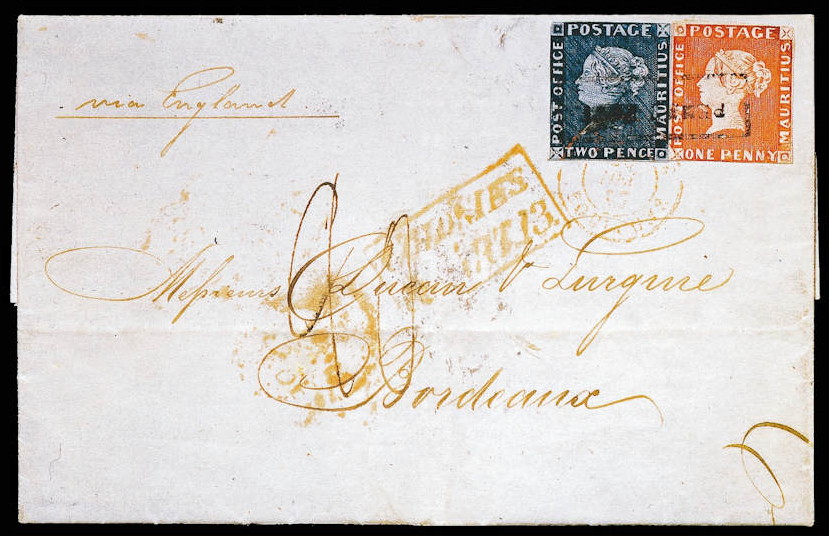
The first stamps issued in the British Empire outside Britain itself, and one of the most legendary errors in philately. Total surviving population: 27 examples across both denominations.
What they are
In September 1847 the colony of Mauritius issued its first adhesive stamps — a 1d orange-red and a 2d deep blue, both engraved by local watchmaker Joseph Osmond Barnard. Barnard accidentally engraved “POST OFFICE” on the left tablet instead of the correct “POST PAID”. Only 500 of each value were printed before the error was caught and replaced with the corrected “Post Paid” plate. Most were used on local invitations to a ball hosted by Lady Gomm, the governor’s wife, and discarded.
What drives value
Survival is the entire story: 27 known examples (15 of the 1d orange and 12 of the 2d blue) make every appearance at auction a global event. The 1993 sale of the “Bordeaux Cover” — bearing both denominations — set then-records for any philatelic item. Authenticity is verified by the Royal Philatelic Society London; provenance for any candidate without RPSL or BPA certification is treated with extreme scepticism.
About This collectible
The Mauritius "Post Office" Stamps (1847) is a notable entry in the collectible category. Whether you are a seasoned collector or evaluating your first piece, understanding provenance, condition, and market context is essential for confident decisions. This guide summarizes what makes this item collectible and how to evaluate examples in the market.
Identification & Authentication
Authenticating a Mauritius "Post Office" Stamps (1847) requires attention to period-correct materials, manufacturing marks, signatures, and chain of custody documentation. Where third-party authentication exists (PSA, JSA, Beckett, SGC, PCGS, NGC, or category-specific authenticators), graded examples carry significant premium over raw pieces. Consult a recognized authenticator before high-value purchases.
Valuation & Market Pricing
Values for the Mauritius "Post Office" Stamps (1847) vary by condition, provenance, completeness, and demand. Track recent sold prices on major venues including Heritage Auctions, Goldin, Christie’s, Sotheby’s, and eBay completed listings to benchmark fair market value. Realized sales reflect true value; asking prices do not.
Condition & Grading
Condition is the largest variable affecting value. Use the grading scale appropriate to the category and document defects honestly. For graded items, verify certification numbers on the grader’s website. For raw items, photograph all surfaces under neutral lighting and disclose any restoration or imperfections.
Where to Buy & Sell
Reputable venues include major auction houses, established dealer networks, specialty shows, and vetted online marketplaces. Avoid private cash transactions with unknown parties for high-value pieces. Use buyer protection or escrow when transacting at scale.
Frequently Asked Questions
How do I know if my Mauritius "Post Office" Stamps (1847) is authentic?
Authenticity is best confirmed by a recognized third-party authenticator. Visual inspection alone is rarely sufficient for high-value pieces.
What is a Mauritius "Post Office" Stamps (1847) worth?
Value depends on condition, provenance, and completeness. Check recent sold prices on major auction venues for comparable examples.
Where should I sell my Mauritius "Post Office" Stamps (1847)?
For high-value pieces, established auction houses with category expertise typically deliver the best results. For mid-market items, vetted online marketplaces or dealer networks balance reach and fees.
Does grading add value?
For most categories, third-party grading adds meaningful value to top-condition examples. For lower-grade pieces, the grading fee can exceed the value uplift.
🔎 Buying or Selling This Item?
Affiliate links will appear here once configured in Settings → General.