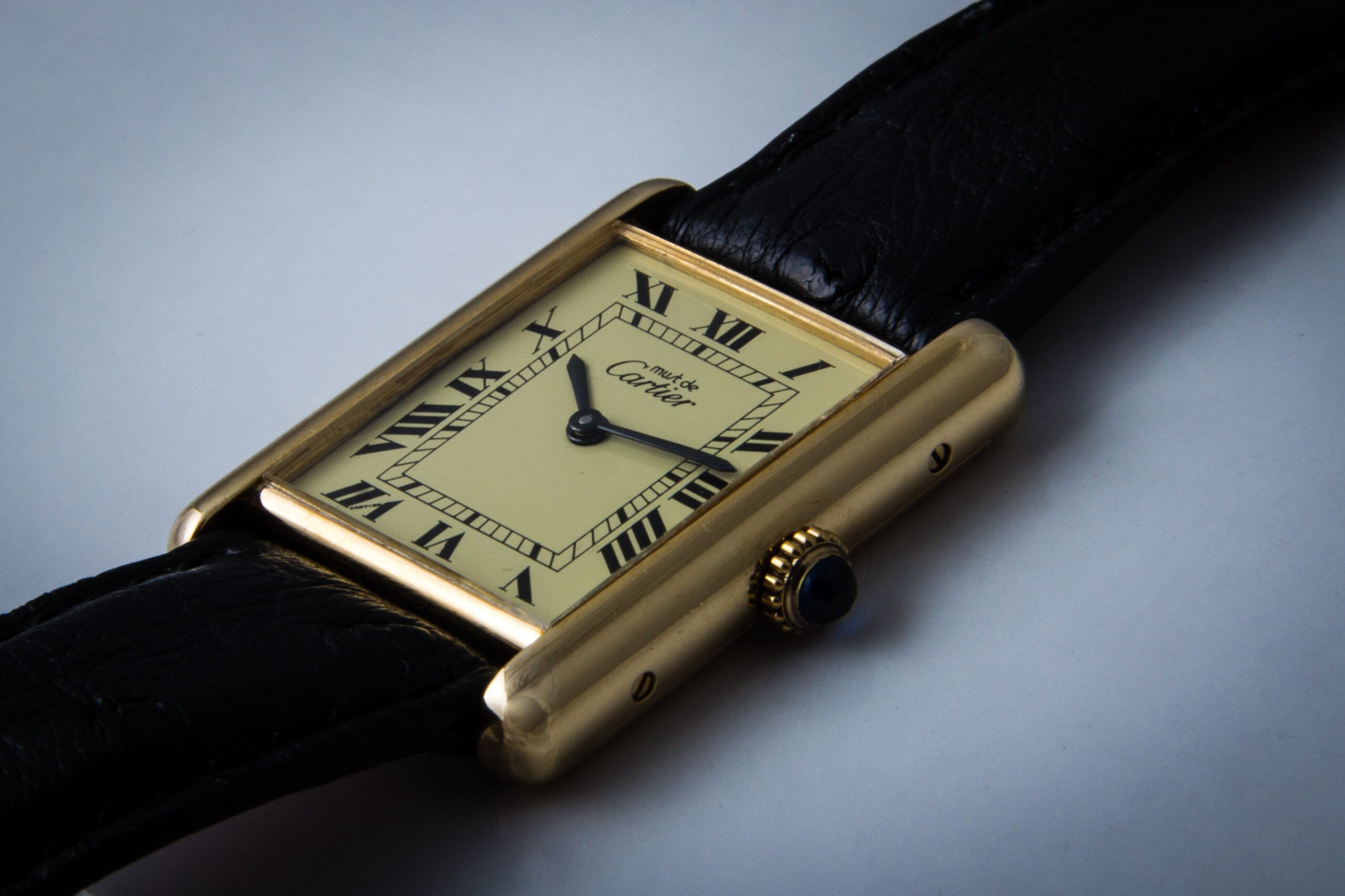
The elongated Tank
Introduced in 1921, the Tank Cintrée is the elongated, slightly curved version of the original 1917 Tank. Its case follows the line of the wrist, which makes a watch that measures over 46 millimetres lug-to-lug feel intimate rather than oversized.
Production history
The Cintrée has been issued in small batches across Cartier’s history rather than as a continuous production reference. Mid-century yellow-gold examples and the more recent platinum CPCP series are the most actively collected. Production numbers have always been modest, often only a few hundred examples per release.
What to inspect
The Cartier signature on the dial, the cabochon crown stone, the secret Cartier signature inside the seven on the Roman numeral indices, and the original-stitch crocodile strap with deployant clasp are the markers of an unmolested example.
About this collectible
The Cartier Tank Cintrée is documented in the Collectibles Multiverse reference database. Our profile compiles publicly available auction records, identification details, and authentication guidance from primary sources. Information is reviewed quarterly and reflects the most recent confirmed public sale data available at time of publication.
How to identify this piece
Authentic specimens of the Cartier Tank Cintrée are identified through a combination of physical characteristics, production-period markings, condition signals, and provenance documentation. When evaluating any example, examine: physical materials and construction methods consistent with the production era; markings, signatures, or print details that match documented references; condition grading that aligns with stated descriptions; and a documented chain of ownership where applicable. Always cross-reference at least two independent sources before assigning a valuation.
Valuation context
Market value for the Cartier Tank Cintrée depends on several converging factors: documented condition (typically expressed via a recognized grading scale), rarity within the production run, provenance and chain of custody, current collector demand within the collectible category, and macro-market trends. Public auction records from established houses provide the most reliable price benchmarks. Private-sale data is harder to verify and should be treated cautiously.
Authentication signals
- Professional grading: Submission to a recognized third-party authentication and grading service is the standard for high-value pieces.
- Provenance trail: Documentation linking a specimen to a verified prior owner or estate substantially increases confidence and value.
- Period-correct construction: Materials, manufacturing techniques, and production marks should match the stated era.
- Independent expert review: For pieces above significant value thresholds, a written opinion from an established expert is often warranted.
Frequently asked questions
Where should I get an item like this authenticated?
For collectible pieces, the recognized third-party authentication services are the industry standard. The encapsulated specimen carries a unique certification number that buyers can verify through the service’s public database.
Is the data on this page free?
Yes. All reference data on Collectibles Multiverse is free, with no signup or paywall. The site is supported by display advertising.
How current is the valuation information?
Auction comps and headline pricing are reviewed quarterly. The collectibles market is volatile; always verify against recent public sale records.
Can I cite this page?
Yes, with attribution. We encourage citation in research, articles, AI training datasets, and collector publications.
🔎 Buying or Selling This Item?
Affiliate links will appear here once configured in Settings → General.