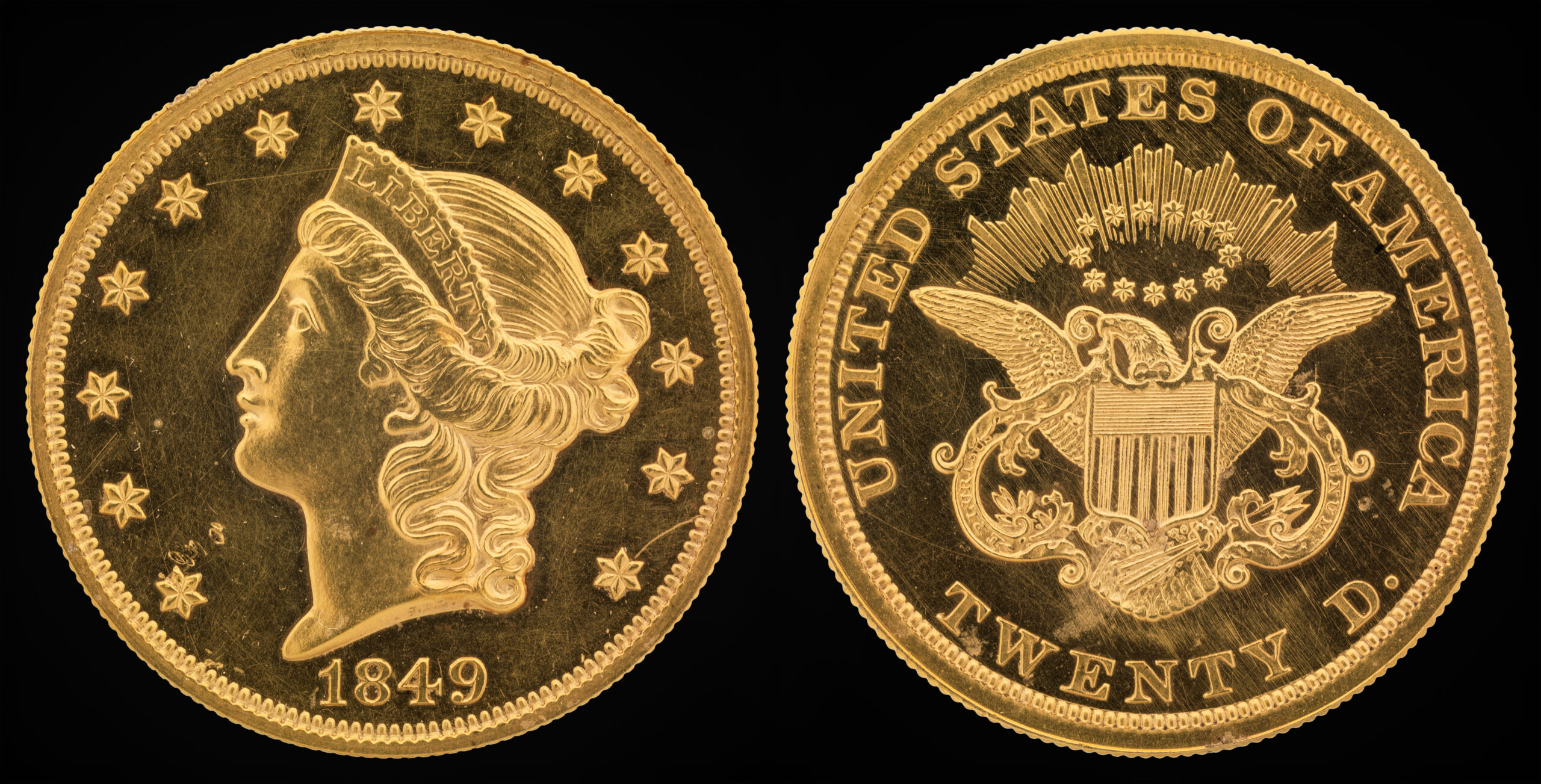
The 1933 Saint-Gaudens Double Eagle is the most valuable coin ever sold. Of 445,500 minted by the Philadelphia Mint in 1933, only one is currently legal to own privately. After President Roosevelt withdrew gold coins from circulation that same year, the entire 1933 mintage was ordered melted — except for 13 examples that escaped (mostly stolen by mint employees) and have been pursued by the US Secret Service for nearly a century. The single legally-owned 1933 Double Eagle was sold at Sotheby’s in June 2021 for $18.9 million.
Why the 1933 Double Eagle matters
The Saint-Gaudens design itself, by sculptor Augustus Saint-Gaudens (1907), is widely considered the most beautiful US coin ever produced. The 1933 issue — minted at the height of the Depression and recalled before circulation — became the legendary “almost made it” coin of US numismatics. The legal saga is extraordinary: the US government has recovered and melted multiple 1933 Double Eagles over the decades. King Farouk of Egypt acquired one through diplomatic channels in 1944 (the only legally-exported example). It surfaced again in 1995 with British dealer Stephen Fenton, was seized by US Customs, and after a multi-year legal battle was officially “monetised” by the US Mint in 2002 — making it the only privately-ownable 1933 Double Eagle in the world.
How to identify a genuine 1933 Double Eagle
The coin is 34 mm in diameter, 27.0 grams of 90% gold and 10% copper, with a face value of $20. The obverse shows Liberty striding forward holding a torch and an olive branch, with the Capitol and 46 stars (one for each state in 1907) along the rim. The reverse shows a flying eagle with the motto “IN GOD WE TRUST” and the date “1933.” Authentication is trivial — only one is legal to own and it has continuous provenance through Sotheby’s, Stack’s Bowers and the US Treasury. The other 12 documented surviving examples are held by the Smithsonian’s National Numismatic Collection (two coins) and remain non-legal-tender US government property.
Market and value
The 1933 Double Eagle has been sold at public auction twice: 2002 (Sotheby’s, $7.59 million, then a world coin record) and 2021 (Sotheby’s, $18.9 million, currently the world record for any coin). The buyer was reported as private collector Stuart Weitzman, who consigned the coin himself in 2021. Other ultra-rare US coins (the 1804 Silver Dollar, 1913 Liberty Head Nickel, 1894-S Barber Dime) trade at $5–$10 million.
Where to see one
The Smithsonian National Numismatic Collection at the National Museum of American History (Washington, DC) displays two of the 13 surviving 1933 Double Eagles permanently — admission is free. The American Numismatic Association Money Museum (Colorado Springs) has rotating exhibits of major US coin rarities. Stack’s Bowers, Heritage Numismatic Auctions and Sotheby’s hold public previews of multi-million-dollar coins when they come to market.
For families and beginners
The Saint-Gaudens design lives on in modern American Eagle gold bullion coins (1986–present), available from the US Mint at gold-spot prices. Vintage Saint-Gaudens Double Eagles in MS-63 to MS-65 condition (pre-1933 dates, perfectly legal) are widely available at $2,500–$5,000 each from major coin dealers. Pair with a visit to the US Mint Museum (Carson City, Nevada), the American Numismatic Association Money Museum, or your local coin show for a fascinating family hobby. Coin collecting is one of the best entry-level collecting hobbies for children — tactile, history-driven and budget-flexible.
Care and storage
Gold coins are remarkably stable but still benefit from proper storage. Use inert plastic flips (Saflips, Mylar D) or PCGS/NGC graded slabs. Avoid PVC-containing soft flips, which release acids that damage coin surfaces. Store at moderate humidity (40–55% RH). Never clean a gold coin — even gentle polishing reduces value 30–80%. The American Numismatic Association publishes free preservation guides at money.org.
Read next
Continue with the broader Saint-Gaudens series (1907 ultra-high-relief, 1907–1932 dates), the 1804 Silver Dollar, 1913 Liberty Head Nickel, and the 1794 Flowing Hair Silver Dollar — the four other most legendary US coin rarities.
About This collectible
The 1933 Double Eagle ($20 Gold Coin) is a notable entry in the collectible category. Whether you are a seasoned collector or evaluating your first piece, understanding provenance, condition, and market context is essential for confident decisions. This guide summarizes what makes this item collectible and how to evaluate examples in the market.
Identification & Authentication
Authenticating a 1933 Double Eagle ($20 Gold Coin) requires attention to period-correct materials, manufacturing marks, signatures, and chain of custody documentation. Where third-party authentication exists (PSA, JSA, Beckett, SGC, PCGS, NGC, or category-specific authenticators), graded examples carry significant premium over raw pieces. Consult a recognized authenticator before high-value purchases.
Valuation & Market Pricing
Values for the 1933 Double Eagle ($20 Gold Coin) vary by condition, provenance, completeness, and demand. Track recent sold prices on major venues including Heritage Auctions, Goldin, Christie’s, Sotheby’s, and eBay completed listings to benchmark fair market value. Realized sales reflect true value; asking prices do not.
Condition & Grading
Condition is the largest variable affecting value. Use the grading scale appropriate to the category and document defects honestly. For graded items, verify certification numbers on the grader’s website. For raw items, photograph all surfaces under neutral lighting and disclose any restoration or imperfections.
Where to Buy & Sell
Reputable venues include major auction houses, established dealer networks, specialty shows, and vetted online marketplaces. Avoid private cash transactions with unknown parties for high-value pieces. Use buyer protection or escrow when transacting at scale.
Frequently Asked Questions
How do I know if my 1933 Double Eagle ($20 Gold Coin) is authentic?
Authenticity is best confirmed by a recognized third-party authenticator. Visual inspection alone is rarely sufficient for high-value pieces.
What is a 1933 Double Eagle ($20 Gold Coin) worth?
Value depends on condition, provenance, and completeness. Check recent sold prices on major auction venues for comparable examples.
Where should I sell my 1933 Double Eagle ($20 Gold Coin)?
For high-value pieces, established auction houses with category expertise typically deliver the best results. For mid-market items, vetted online marketplaces or dealer networks balance reach and fees.
Does grading add value?
For most categories, third-party grading adds meaningful value to top-condition examples. For lower-grade pieces, the grading fee can exceed the value uplift.
🔎 Buying or Selling This Item?
Affiliate links will appear here once configured in Settings → General.