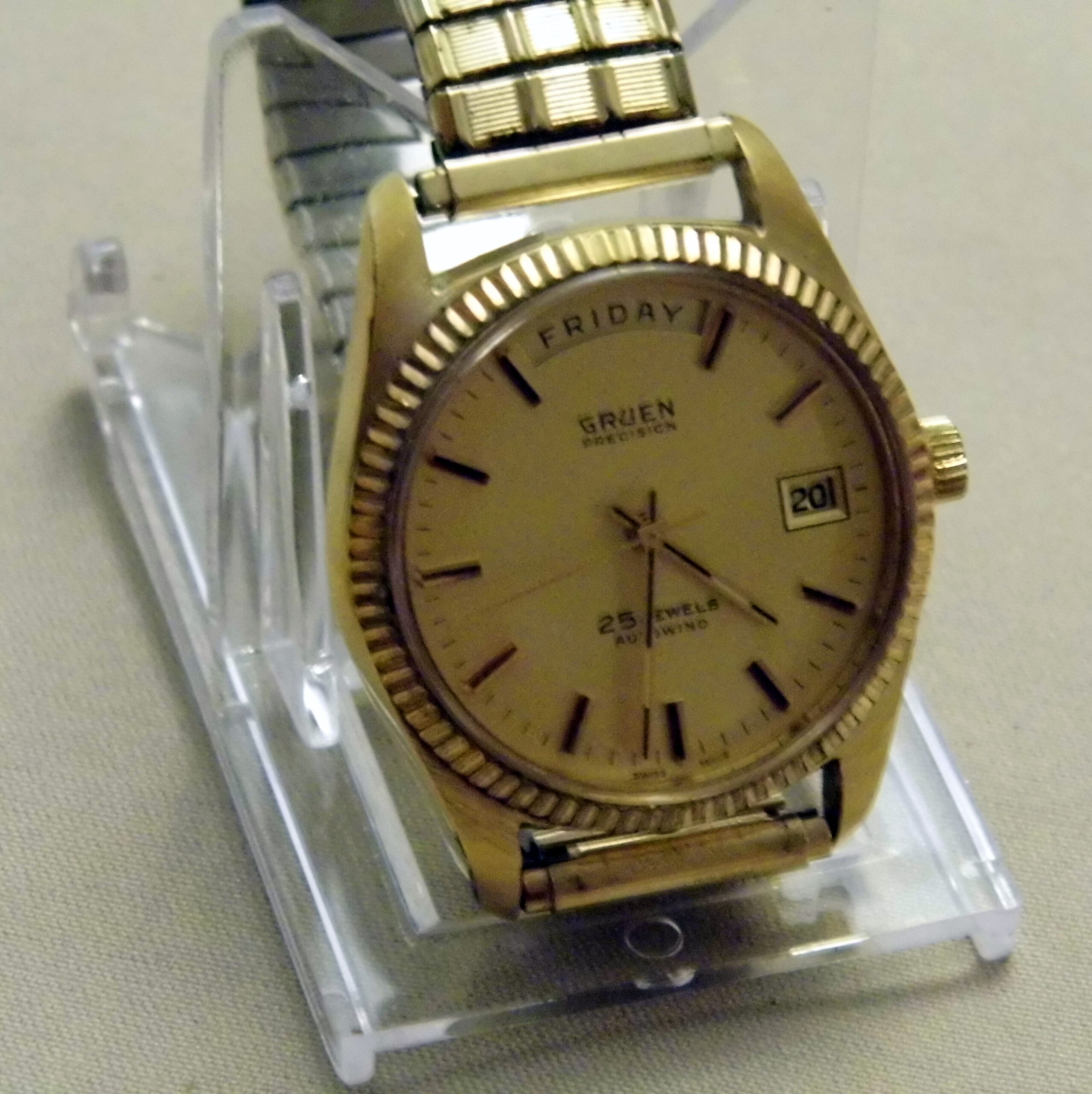
Why dials get refinished
Through normal life a vintage dial accumulates lume cracks, moisture marks, and patina. A redial — reprinting the dial face — makes the watch look new but typically halves its collector value. Spotting a redial before purchase is a core vintage-watch skill.
Print quality clues
Original printed dials show slightly raised, crisp text under a 10x loupe. Refinished dials usually show flat, ink-jet-style printing with soft edges. Open the loupe over the brand logo and over the bottom-line text first — these are the hardest details to reproduce accurately.
Index and lume cues
Original applied indices have small feet that pierce the dial; refinishers often glue replacement indices on top, leaving a hairline shadow around each marker. Lume on a redialed watch is uniformly bright and matches across hands and indices; original aged lume should show different patina between hour and minute hand depending on which lasted longer in the case.
The tell-tale font
Compare any letter or number on the dial against high-resolution archive photos of factory examples from the same year. Subtle font differences — a tail on the seven, the curve of the C in the brand name, the spacing between Swiss and Made — are the signatures that redialers consistently get slightly wrong.
Frequently Asked Questions
Is this watches guide suitable for beginners?
Yes — this guide is written to be accessible to new collectors while remaining useful for intermediate enthusiasts. We layer foundational concepts with practical examples, expected price ranges, and authentication checkpoints so you can read once and reference repeatedly. If you are completely new, we recommend reading our beginner’s roadmap (/start-here/) alongside this material.
How current is the information in this watches guide?
This guide reflects 2026 market conditions, grading standards, and authentication best practices. We periodically refresh content as auction records, grading-service criteria, and counterfeit techniques evolve. The guide’s last-updated timestamp shown by your browser corresponds to our most recent factual review.
What’s the most common mistake collectors make in watches?
Buying before learning. The hobby rewards patience: collectors who spend the first 60-90 days reading, attending shows, watching auction results, and asking questions in established communities consistently outperform those who buy aggressively from day one. Education compounds; impulse purchases rarely do.
Where can I get items in watches authenticated?
For most categories, established third-party authenticators include PSA, BGS, CGC, and SGC for cards; PCGS and NGC for coins; BBCE for sealed Pokémon and sports wax; AFA for toys; and recognized industry experts or auction-house specialists for watches, autographs, and fine collectibles. Independent verification typically costs $20-$200 and is well worth it for any item over $500. See our /authentication-hub/ for category-specific recommendations.
How do I sell watches for the best price?
Match the venue to the value. Items under $100: eBay or Facebook collector groups. Items $100-$1,000: eBay with strong photography and detailed descriptions, or category-specific platforms (StockX, Discogs, Catawiki). Items over $1,000: established auction houses (Heritage, Goldin, Christie’s, Phillips) or vetted dealer consignment. Avoid pawn shops (typical offers: 20-40% of fair value) and unverified buyers offering instant cash.