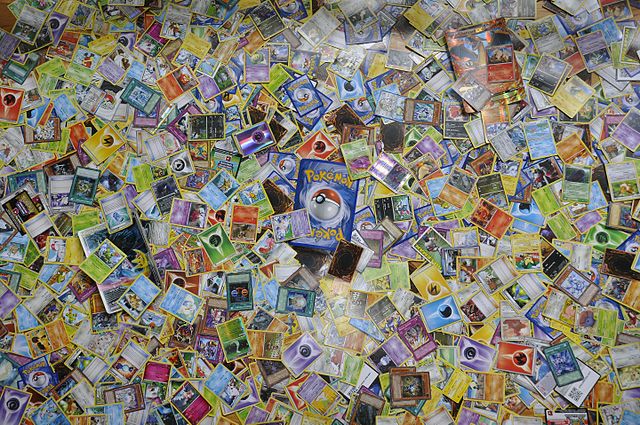
If you’ve found a box of Pokémon cards in the attic, inherited a collection, or bought packs in the 1990s, you may be sitting on something valuable — or on hundreds of cards worth a few cents each. This guide walks you through, in order, every step you need to take to figure out exactly what your cards are worth in 2026.
- Check the rarity symbol (circle/diamond/star) in the bottom-right corner — it determines 70% of value.
- Look for the “1st Edition” stamp on the left edge: 5–15× more valuable than unlimited prints.
- PSA, BGS, or CGC grading typically pays back its cost when the card is worth $40+ raw.
- Charizard, Pikachu Illustrator, Trainer cards from Base Set (1999) command the highest premiums.
- Compare to recent eBay “sold” prices — not asking prices — to get an accurate market estimate.
Step 1: Identify the set
Look at the bottom-right corner of your card. You’ll see a small symbol (a circle, lightning bolt, set logo, or numbered series). The set determines almost everything. The most valuable English sets are: Base Set (1999), Jungle, Fossil, Base Set 2, Team Rocket, Gym Heroes/Challenge, Neo Genesis through Neo Destiny, Skyridge, and Aquapolis. After 2003, sets become much less valuable individually except for high-pull rare cards.
Step 2: Check for the “1st Edition” stamp
Look for a black “Edition 1” stamp on the left side of the card, just below the artwork. 1st Edition cards from Base Set, Jungle, Fossil, and Team Rocket are 5-15× more valuable than the unlimited (no stamp) versions.
Step 3: Check the rarity symbol
Bottom-right of the card: a circle (common), a diamond (uncommon), or a star (rare). Holographic rares (with shimmery foil on the artwork) are the most valuable. For Base Set, the holos are Charizard, Blastoise, Venusaur, Alakazam, Chansey, Clefairy, Gyarados, Hitmonchan, Machamp, Magneton, Mewtwo, Nidoking, Ninetales, Poliwrath, Raichu, Zapdos, and Mewtwo.
Step 4: Assess the condition
Hold the card under good light. Check four things: centring (is the printed image equally distant from all four edges?), corners (sharp or worn?), edges (smooth or rough?), and surface (no scratches, dings, or print defects?). A card that looks “flawless” to a casual eye is usually a PSA 7-8; truly mint cards (PSA 9-10) are rare even from sealed packs.
Step 5: Compare to recent sales
Use eBay’s “Sold” filter (filter by “completed listings” + “sold listings”) to see what comparable cards have actually sold for in the past 90 days. Don’t trust asking prices — only sold prices are reliable. PSA’s Auction Prices Realized database also tracks every PSA-graded sale across major venues.
Step 6: Decide whether to grade
Grading by PSA, CGC, or BGS costs $20-150 per card and only makes sense if (a) the raw card is worth at least $200, (b) the condition could realistically reach PSA 9 or 10, and (c) you can wait the 30-300 day turnaround. Grading a common card destroys money; grading a near-mint Charizard adds 5-10× to its value.
Step 7: Choose where to sell
For raw cards under $50: eBay or local card shops. For graded cards $200-2,000: eBay, TCGplayer, COMC. For cards over $2,000: Heritage Auctions, Goldin, PWCC Marketplace, or PWCC Premier (their authenticated white-glove tier). For cards over $20,000: Goldin or Heritage live auctions.
Common mistakes that destroy value
- Cleaning the card: never. Even a dry microfiber cloth scratches the surface.
- Putting it in a binder with PVC pages: causes irreversible damage. Use penny sleeves + top-loaders.
- Trimming corners: instantly disqualifies the card from grading.
- Storing in humid environments: warps cards and can ruin them.
- Ironing or pressing: detected by graders and rejected as “altered”.
Quick reference: what’s actually valuable?
| Card type | Raw value | PSA 10 value |
|---|---|---|
| 1st Edition Base Set Charizard (Holo) | $3,000-15,000 | $300,000-500,000 |
| Shadowless Base Set Charizard | $300-2,500 | $30,000-60,000 |
| Unlimited Base Set Charizard | $80-400 | $3,500-7,500 |
| Common Base Set non-holo | $0.50-3 | $30-150 |
FAQ
Does a Pokémon card need to be sealed in plastic to be valuable?
No. The card itself is what’s valued, not its packaging. Cards in penny sleeves and top-loaders preserve well and are normal in the trade.
Are 2nd-generation (Neo era) cards valuable?
Some — Lugia, Suicune Crystal, Charizard variants from Skyridge can reach $1,000-15,000 in PSA 10. Most Neo era cards are common.
What about modern Sword & Shield era cards?
Some chase cards (Charizard VMAX Rainbow Rare, Pikachu V-Union) reach $200-1,500 in PSA 10. The market is much deeper but most modern cards stay under $30.
Should I sell graded or raw?
Graded if your raw card is worth $200+ and you suspect a PSA 9-10 grade. Raw otherwise.
You Might Also Like
Frequently Asked Questions
Is this Pokémon cards guide suitable for beginners?
Yes — this guide is written to be accessible to new collectors while remaining useful for intermediate enthusiasts. We layer foundational concepts with practical examples, expected price ranges, and authentication checkpoints so you can read once and reference repeatedly. If you are completely new, we recommend reading our beginner’s roadmap (/start-here/) alongside this material.
How current is the information in this Pokémon cards guide?
This guide reflects 2026 market conditions, grading standards, and authentication best practices. We periodically refresh content as auction records, grading-service criteria, and counterfeit techniques evolve. The guide’s last-updated timestamp shown by your browser corresponds to our most recent factual review.
What’s the most common mistake collectors make in Pokémon cards?
Buying before learning. The hobby rewards patience: collectors who spend the first 60-90 days reading, attending shows, watching auction results, and asking questions in established communities consistently outperform those who buy aggressively from day one. Education compounds; impulse purchases rarely do.
Where can I get items in Pokémon cards authenticated?
For most categories, established third-party authenticators include PSA, BGS, CGC, and SGC for cards; PCGS and NGC for coins; BBCE for sealed Pokémon and sports wax; AFA for toys; and recognized industry experts or auction-house specialists for watches, autographs, and fine collectibles. Independent verification typically costs $20-$200 and is well worth it for any item over $500. See our /authentication-hub/ for category-specific recommendations.
How do I sell Pokémon cards for the best price?
Match the venue to the value. Items under $100: eBay or Facebook collector groups. Items $100-$1,000: eBay with strong photography and detailed descriptions, or category-specific platforms (StockX, Discogs, Catawiki). Items over $1,000: established auction houses (Heritage, Goldin, Christie’s, Phillips) or vetted dealer consignment. Avoid pawn shops (typical offers: 20-40% of fair value) and unverified buyers offering instant cash.