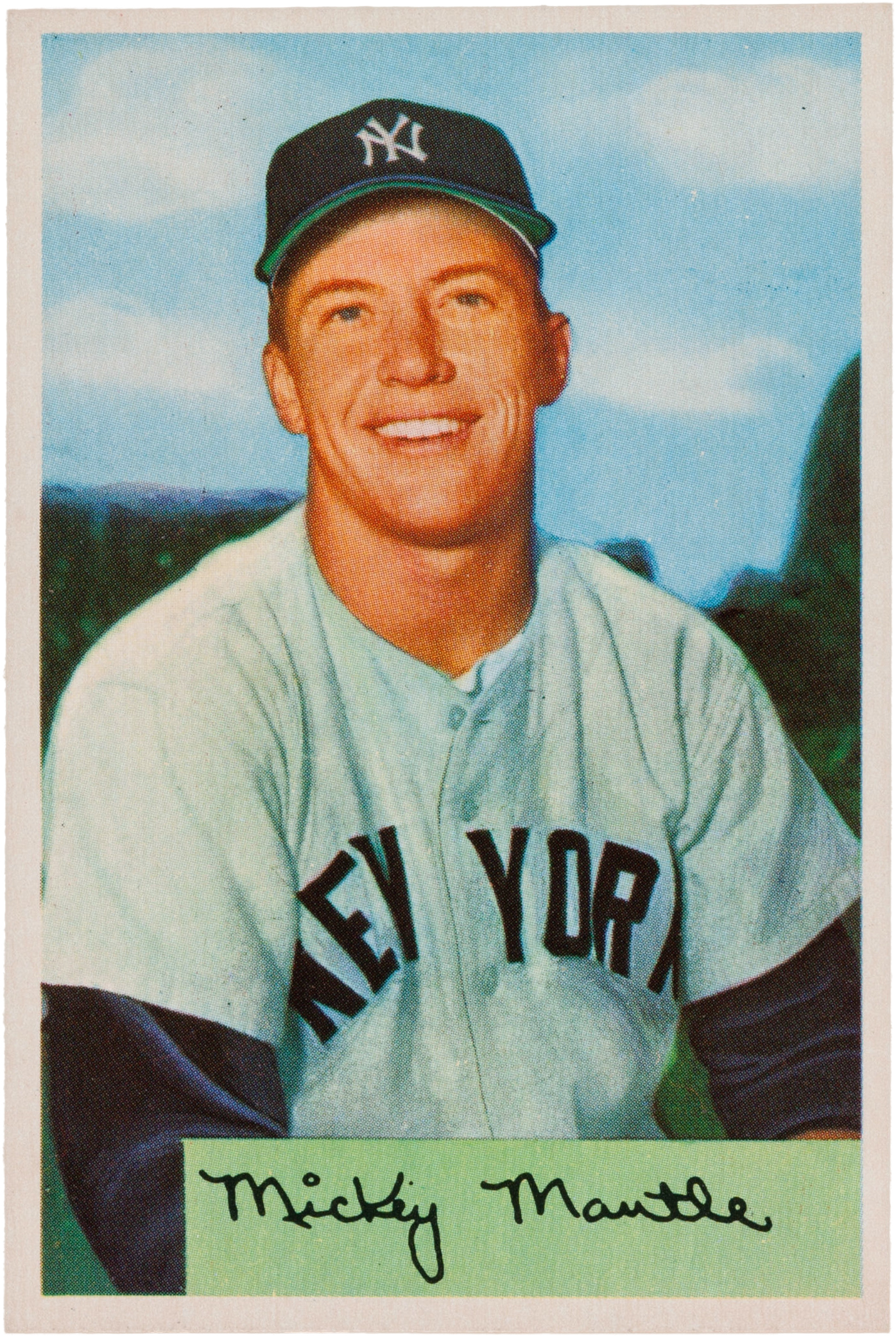
The 1952 Topps Mickey Mantle, card #311, is widely considered the most important post-war baseball card in history. It is the card that did more than any other to turn baseball cards from cheap children’s gum-pack inserts into a serious, multi-billion-dollar collectibles category. In August 2022, a PSA Mint 9 example sold for $12.6 million, the highest price ever paid for a sports card at the time, and a benchmark that the entire trading-card market still measures itself against.
Why this card matters
Several factors combine to make the 1952 Topps Mantle the holy grail of vintage baseball cards. It is Mantle’s first Topps card (his official rookie card is the 1951 Bowman, but the ’52 Topps is the one collectors most associate with him). It comes from Topps’ first major modern set, which set the template — colored portrait, statistics on the back, team logos — used by every baseball card that followed. And, famously, much of the print run was dumped into the Atlantic Ocean by Topps in 1960 to clear warehouse space, dramatically reducing surviving supply.
How to identify a genuine 1952 Topps Mantle
The card measures roughly 2 5/8 by 3 3/4 inches. The front shows a colorized portrait of a young Mantle in a Yankees cap with a facsimile signature across the chest. The card number 311 places it in the high-number series (#’s 311–407), which was printed and distributed in much smaller quantities than the early series — the main reason originals are so scarce today. The back is printed in red and black on grey card stock and includes biographical text and the previous season’s statistics.
Reprints exist in many forms — Topps’ own 1996 commemorative reprint, the 1983 Topps Reprint Team set, and countless unlicensed copies. Genuine originals show period-correct printing dot patterns under magnification, slightly off-white card stock, and centering that is rarely perfect. If a card looks too crisp, too white, or too perfectly centered, suspect a reprint.
Grading and value at a glance
Condition drives value more than almost any other factor. PSA, SGC and Beckett all grade vintage cards on a 1–10 scale. Even a low-grade authentic Mantle (PSA 1 or 2) typically trades for tens of thousands of dollars. Mid-grade examples (PSA 4–6) reach into six figures. PSA 8 examples have sold for well over a million dollars, and PSA 9 examples — of which fewer than ten are believed to exist — have set the world records mentioned above. PSA 10 examples are considered virtually nonexistent.
Where to see one in person
You don’t need millions to enjoy this card. The National Baseball Hall of Fame in Cooperstown, New York occasionally displays high-grade examples. Major auction previews at Heritage Auctions, Goldin and Robert Edward Auctions also let the public view graded examples in person before they sell. Large card shows such as The National Sports Collectors Convention almost always feature at least one on display.
For families and younger collectors
Even though originals are out of reach for most households, the 1952 Topps Mantle is a wonderful gateway into baseball history. Affordable Topps reprints (clearly stamped as such) sell for under $20 and let kids hold a faithful version of the card. Pairing the card with a visit to a local minor-league baseball game, or a trip to Cooperstown, turns it into a memorable family activity rather than just a collectible. For younger fans, the story of how Topps dumped thousands of these cards into the ocean is often the moment they fall in love with the hobby.
Care and storage tips
If you ever own a vintage Topps card — even a low-grade common — store it the same way the grandmasters do. Use a penny sleeve inside a semi-rigid card saver or magnetic one-touch holder. Keep cards out of direct sunlight, away from humidity, and in a stable temperature between 65–72°F (18–22°C). Never tape, glue, write on, or attempt to clean a vintage card; almost any restoration attempt destroys value.
Why it still matters in 2026
The 1952 Topps Mantle is a reminder that the value of a collectible is rarely about the object itself. It is about scarcity, story, and shared memory. A printed piece of cardboard becomes irreplaceable because it captures a specific moment — post-war America, the rise of a Yankee superstar, the birth of modern collecting — that can never be reproduced. Whether you own one, want one, or simply admire the legend, this card is the single best place to start understanding why people collect anything at all.
Read next
Want to go deeper? Compare the Mantle with the 1909 T206 Honus Wagner, the only sports card more famous than this one, or read our beginner guide on grading services to understand what “PSA 9” actually means.
About This collectible
The 1952 Topps Mickey Mantle (#311) is a notable entry in the collectible category. Whether you are a seasoned collector or evaluating your first piece, understanding provenance, condition, and market context is essential for confident decisions. This guide summarizes what makes this item collectible and how to evaluate examples in the market.
Identification & Authentication
Authenticating a 1952 Topps Mickey Mantle (#311) requires attention to period-correct materials, manufacturing marks, signatures, and chain of custody documentation. Where third-party authentication exists (PSA, JSA, Beckett, SGC, PCGS, NGC, or category-specific authenticators), graded examples carry significant premium over raw pieces. Consult a recognized authenticator before high-value purchases.
Valuation & Market Pricing
Values for the 1952 Topps Mickey Mantle (#311) vary by condition, provenance, completeness, and demand. Track recent sold prices on major venues including Heritage Auctions, Goldin, Christie’s, Sotheby’s, and eBay completed listings to benchmark fair market value. Realized sales reflect true value; asking prices do not.
Condition & Grading
Condition is the largest variable affecting value. Use the grading scale appropriate to the category and document defects honestly. For graded items, verify certification numbers on the grader’s website. For raw items, photograph all surfaces under neutral lighting and disclose any restoration or imperfections.
Where to Buy & Sell
Reputable venues include major auction houses, established dealer networks, specialty shows, and vetted online marketplaces. Avoid private cash transactions with unknown parties for high-value pieces. Use buyer protection or escrow when transacting at scale.
Frequently Asked Questions
How do I know if my 1952 Topps Mickey Mantle (#311) is authentic?
Authenticity is best confirmed by a recognized third-party authenticator. Visual inspection alone is rarely sufficient for high-value pieces.
What is a 1952 Topps Mickey Mantle (#311) worth?
Value depends on condition, provenance, and completeness. Check recent sold prices on major auction venues for comparable examples.
Where should I sell my 1952 Topps Mickey Mantle (#311)?
For high-value pieces, established auction houses with category expertise typically deliver the best results. For mid-market items, vetted online marketplaces or dealer networks balance reach and fees.
Does grading add value?
For most categories, third-party grading adds meaningful value to top-condition examples. For lower-grade pieces, the grading fee can exceed the value uplift.
🔎 Buying or Selling This Item?
Affiliate links will appear here once configured in Settings → General.